GOS:Pr Scintillator:
Basic Properties:
| Density(g/cm3) | 7.34 | Atomic Coefficient | 60 |
| Molecular Formula | Gd2O2S | relative Molecular | 378 |
| Hygroscopicity | None | Refractive Index | 2.2 |
| Melting Point | 2070°C | Crystal Structure | Hexagonal Crystal System |
| Zeff | 61.1 |
Specifications:
| Appearance Dimension Precise | <0.,03mm@42x48mm | Flatness | <0.03@42x48mm |
| Pixel Size Consistency | ±0.01mm | Difference of Edge Reflection Thickness | <±0.05 |
X-ray Photoelectric Property:
| Light Output | 27000 ph/MeV | Peak Wavelength | 512nm |
| Decay Time | 3μs | Afterglow | <0.1%@3ms, <0.01%@100ms |
| Light Output Fluctuation of Difference Pixel | ≦5% | Light Output Fluctuation of Difference Arrays | ≦10% |
| Crosstalk (Cap0.085) | ≦8% | Irradiation Damage of GOS Ceramic Array | 20% of 1 Mrad |
GOS:Tb Scintillator:
Comparison of properties with other materials
| Material | CsI(Tl) | GOS:Tb | GOS:Pr |
| Peak Wavelength | 560 | 550 | 510 |
| Morphology | Cubic | Poly-crystalline Ceramic | Poly-crystalline Ceramic |
| Transparency | Transparent | Translucent | Translucent |
| Light Output/MeV | 59000 | 46500 | 27000 |
| Decay Time/ns | 1 | 600 | 3 |
| Afterglow/@3ms | ≤1% | ≤0.1% | ≤0.05% |
| Atomic Coefficient | 64 | 60 | 60 |
| Density/g-cm3 | 4.51 | 7.34 | 7.34 |
| Hygroscopicity | Slightly | No | No |
| Irradiation Damage | / | 12%(1Mrad) | 6%(1Mrad) |
GOS Ceramics, or Gadolinium Oxysulfide ceramics, are primarily composed of the chemical compound Gadolinium Oxysulfide (Gd2O2S), GOS Ceramics belongs to a hexagonal system structure (space group: P3− ml; lattice parameters: a = b = 0.3851 nm and c = 0.6664 nm) with trigonal symmetry.
Gadolinium oxysulfide (GOS) is an excellent scintillation material because of its high density (7.43 g/cm3) and adequate atomic number of Gd. These characteristics lead to an increased interaction potential possibility for X-ray radiation. Solid-state Gd2O2S (GOS) also exhibits promising chemical and physical characteristics, such as high melting point (2070 ◦C), high X-ray attenuation coefficient (~52 cm−1 at 70 keV), wide band gap (4.6–4.8 eV), favorable chemical durability, low phonon energy, low crystal symmetry, and low toxicity, which make it a promising host material for luminescence and scintillation applications.
Terbium-activated gadolinium oxysulfide (GOS: Tb) finds prominence as a scintillator for X-ray imaging. It emits wavelengths between 382nm and 622nm, with the emission peak positioned at 545nm. GOS: Pr sub-micro phosphors synthesized by the homogeneous precipitation method are promising as a new green emitting material to be applied to the high-resolution digital X-ray imaging field. It is also an excellent green phosphor in projection CRTs.
GOS:Pr (Gadolinium Oxysulfide activated with Praseodymium) exhibits unique luminescent properties. The Pr3+-activated GOS ceramic is an effective ceramic scintillation material for high-quality imaging applications owing to its high X-ray conversion efficiency, strong stopping power for the incident X-ray, short lifetime, fast afterglow, high chemical stability, and good emission, matching with the high sensitivity of silicon photodiodes.
Shanghai North Optics offers GOS: Pr and GOS: Tb Scintillation Materials. Our Pr-doped GOS and Tb-doped GOS feature high light output, low afterglow, and environmental friendliness. We have developed an advanced production line with the required capabilities. Besides, we also offer GOS scintillation screens.
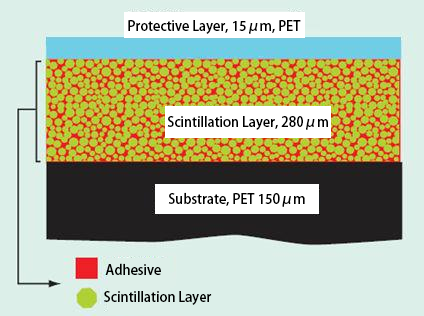
Figure 1. The diagram showing the structure of the GOS scintillation screen
Introduction to The Manufacturing Technique of GOS Scintillation Screen
1. Using the coprecipitation method to produce the mixed powder of Gd2O3 and Tb2O3;
2. High-temperature sulfurization sintering forms GdSO grains;
3. Add adhesives, press the material into pieces, bound the pieces together with the PET substrates;
4. Stick a protective layer onto the light-exiting surface;
5. Gd2OS2:Tb, the emission peak is 550nm.

Chart 1. the chart of the parameters of the thickness of the GOS scintillation layer
Copyright © 2012-2024 All Rights Reserved. 京ICP备01000000号 XML